
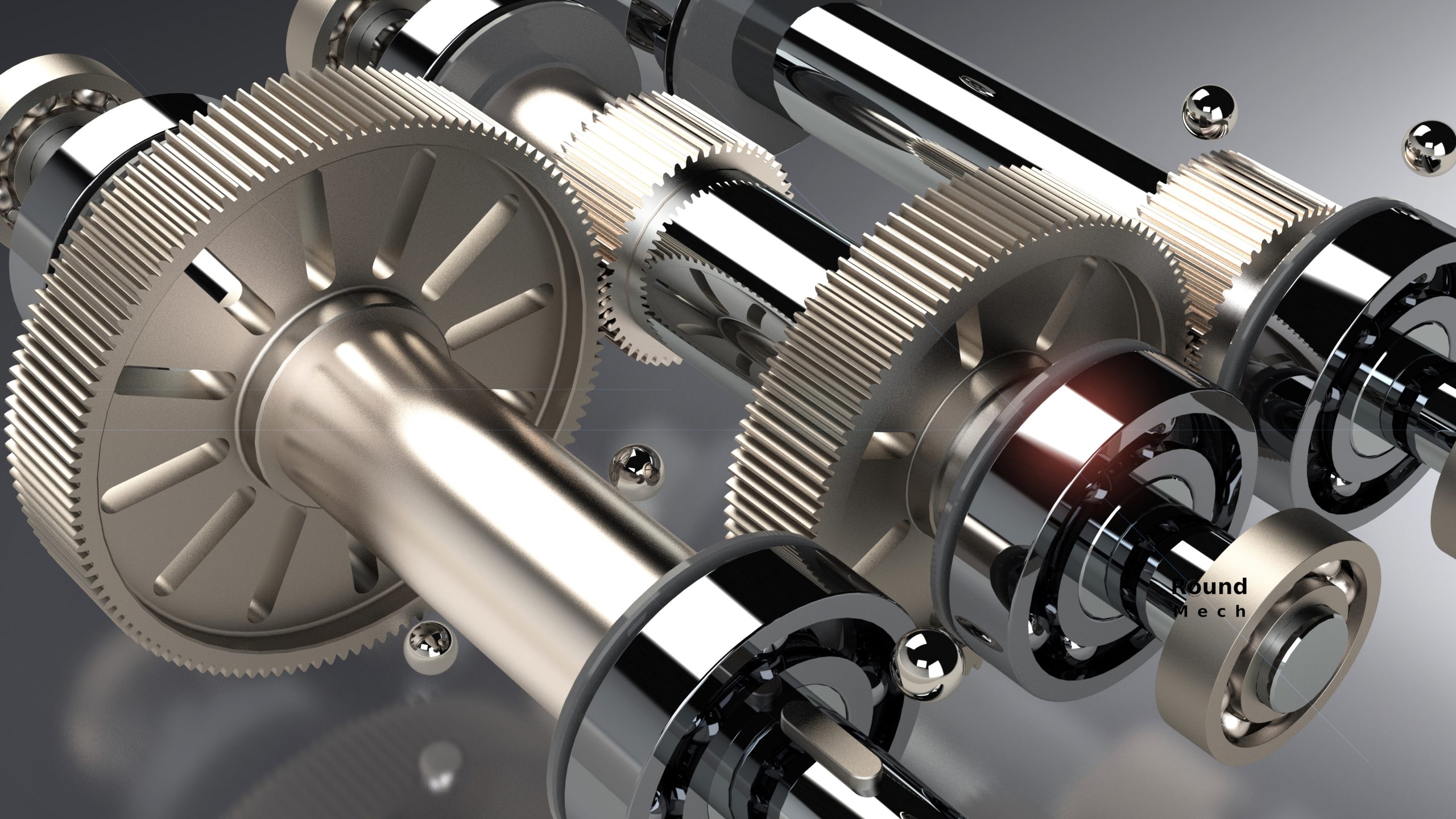
What Are Speed Reduction Gears?
Speed reduction gears decrease the rotational speed of a driving shaft.
They convert a high-speed input into a lower-speed output.
This process also increases the available output torque.
Speed reduction is one of the most common functions of gear systems.
Why Is Speed Reduction Important?
Many electric motors operate at high speed.
However, most industrial machines require lower operating speeds.
A gearbox allows the motor to run efficiently while delivering the correct output speed.
Without speed reduction, many machines would operate too fast or produce insufficient torque.
How Speed Reduction Works
A speed reduction gearbox uses gears with different sizes.
A small driving gear rotates a larger driven gear.
The larger gear turns more slowly.
As the rotational speed decreases, the output torque increases.
This allows the machine to move heavier loads with greater control.
Speed Reduction Formula
The output speed is calculated using:n2=in1
Where:
- n₁ = input speed (RPM)
- n₂ = output speed (RPM)
- i = gear ratio
A higher gear ratio produces a lower output speed.
Practical Example
An electric motor operates at:
- 1500 RPM
The gearbox has a:
- 5:1 gear ratio
Calculation:1500÷5=300RPM
The gearbox reduces the output speed to:
300 RPM
At the same time, the available output torque increases.
Speed Reduction and Torque
Speed and torque are directly related.
When rotational speed decreases, torque increases.
This allows a relatively small motor to drive heavy equipment.
Gearboxes do not create additional power.
They convert speed into usable torque.
Common Applications of Speed Reduction Gears
Speed reduction gear systems are widely used in:
- Industrial gearboxes
- Conveyor systems
- Electric motors
- Hoists and lifting equipment
- Packaging machines
- CNC machines
- Robotics
- Agricultural machinery
- Automotive transmissions
- Material handling equipment
These applications require controlled speed and reliable torque transmission.
Advantages of Speed Reduction Gears
Speed reduction gear systems provide several important benefits:
- Lower output speed
- Higher output torque
- Better machine control
- Improved operating efficiency
- Reduced mechanical stress
- Longer equipment life
- Reliable power transmission
Choosing the Correct Gear Ratio
Selecting the correct gear ratio depends on several factors:
- Motor speed
- Required output speed
- Required torque
- Machine load
- Operating conditions
A properly selected gearbox improves both performance and efficiency.
Example: Conveyor System
A conveyor is driven by an electric motor operating at 1450 RPM.
The conveyor requires an operating speed of approximately 145 RPM.
A gearbox with a 10:1 gear ratio is installed.
The gearbox reduces the speed from 1450 RPM to 145 RPM.
At the same time, the output torque increases by approximately ten times (before mechanical losses).
This provides the force required to move the conveyor safely and efficiently.
Conclusion
Speed reduction gears are essential components in mechanical power transmission.
They reduce rotational speed while increasing available torque.
This allows motors to operate efficiently and machines to deliver the required performance.
Selecting the correct gear ratio improves productivity, efficiency, and equipment reliability.