
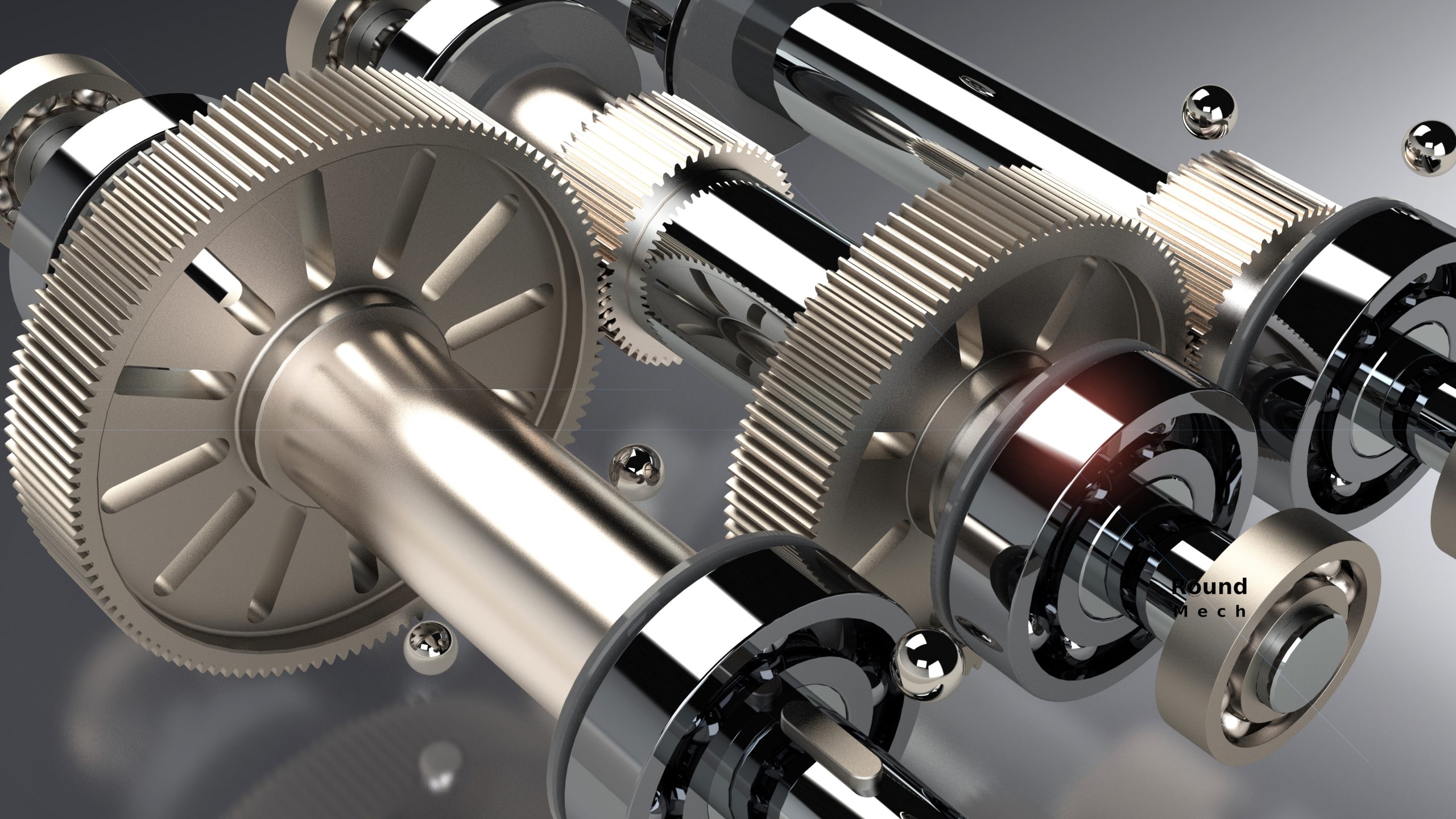
How Gears Change Torque and Speed
Gears are mechanical components used to transfer rotary motion between shafts.
They allow engineers to change the relationship between:
- Torque (rotational force)
- Speed (rotational speed)
A gear system can increase torque while reducing speed.
It can also increase speed while reducing torque.
Gears do not create power.
They only convert speed and torque according to the application requirements.
What Is Torque?
Torque is the rotational force that turns a shaft.
It is measured in:
Newton-meters (Nm)
A higher torque value means that a shaft can produce more turning force.
Example:
- A small motor may rotate fast but have low torque.
- A gearbox can reduce the speed and increase the available torque.
This allows the motor to drive heavier loads.
What Is Speed?
Rotational speed shows how fast a shaft rotates.
It is measured in:
RPM (Revolutions Per Minute)
RPM describes how many complete rotations a shaft makes in one minute.
Example:
- 1500 RPM means the shaft makes 1500 rotations every minute.
How Gear Ratio Works
The gear ratio defines how much the speed and torque will change.
The basic formula is:i=Z1Z2
Where:
- i = gear ratio
- Z1 = number of teeth on the input gear
- Z2 = number of teeth on the output gear
Example: 5:1 Gear Ratio
Input gear:
- 20 teeth
Output gear:
- 100 teeth
Calculation:i=20100=5
The gear ratio is:
5:1
This means:
- Output speed is reduced 5 times.
- Output torque is increased 5 times.
Speed Conversion with Gears
The output speed is calculated using:n2=in1
Where:
- n1 = input speed (RPM)
- n2 = output speed (RPM)
- i = gear ratio
Speed Example
A motor runs at:
1500 RPM
A gearbox has:
5:1 ratio
Calculation:n2=51500
Result:
300 RPM
The gearbox reduces the speed from:
1500 RPM → 300 RPM
Torque Conversion with Gears
The output torque is calculated using:T2=T1×i
Where:
- T1 = input torque
- T2 = output torque
- i = gear ratio
Torque Example
Motor torque:
50 Nm
Gear ratio:
5:1
Calculation:T2=50×5
Result:
250 Nm
The gearbox increases the torque from:
50 Nm → 250 Nm
Real Gear Systems and Efficiency
Real gearboxes have mechanical losses.
Energy is lost because of:
- friction
- bearing losses
- heat generation
- gear tooth contact
The real torque output is:T2=T1×i×η
Where:
- η (eta) = gearbox efficiency
Example:
Input torque:
50 Nm
Gear ratio:
5:1
Efficiency:
90%
Calculation:T2=50×5×0.9
Output torque:
225 Nm
Relationship Between Torque and Speed
Torque and speed are connected through mechanical power.
The basic relationship is:P=9550T×n
Where:
- P = power (kW)
- T = torque (Nm)
- n = speed (RPM)
When speed decreases, torque increases.
When speed increases, torque decreases.
This is the main principle behind gearboxes.
Practical Example: Motor with Gearbox
A motor has:
- Power: 5.5 kW
- Speed: 1450 RPM
- Torque: 36 Nm
A gearbox with:
10:1 ratio
is installed.
Output Speed:
1450÷10=145RPM
Output Torque:
36×10=360Nm
With 90% efficiency:360×0.9=324Nm
Final result:
1450 RPM and 36 Nm
becomes:
145 RPM and approximately 324 Nm
The motor now provides much higher turning force.
Common Applications of Gear Systems
Gearboxes are used in many engineering applications:
- Industrial machines
- Conveyor systems
- Robots
- CNC machines
- Lifting equipment
- Wind turbines
- Automotive systems
- Production lines
Key Engineering Rule
A gear system does not increase power.
It changes the balance between speed and torque.
Lower speed = higher torque
Higher speed = lower torque
This allows engineers to match motors with different mechanical requirements.
Related Tools
Use our engineering calculators to calculate:
- Motor power
- Torque
- RPM
- Gear ratio conversion
- Output torque after gearbox reduction